Will Robots Replace Skilled Workers in the Construction Industry?
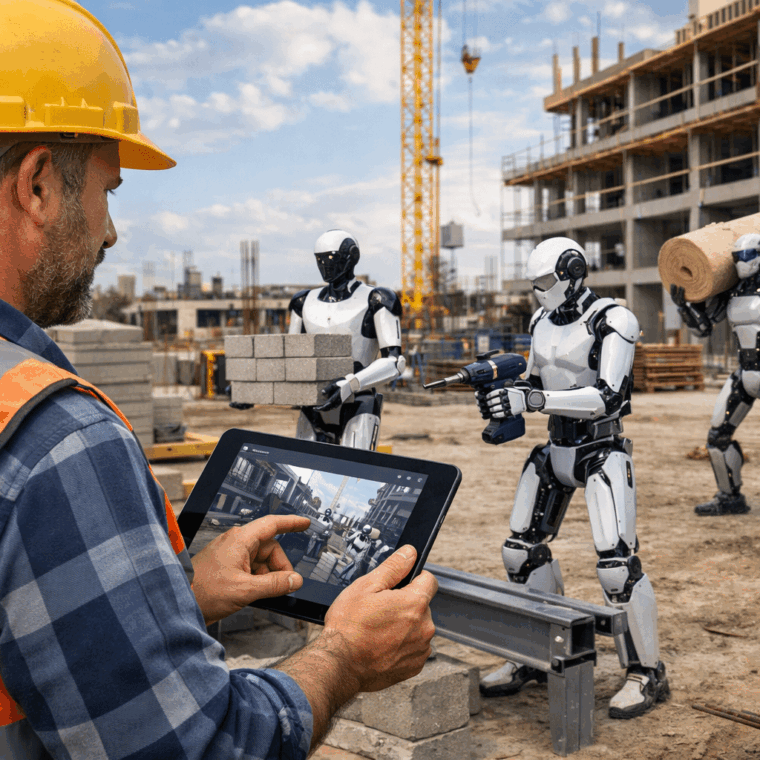
Recent technological advances have sparked discussions about whether human labor can be partially replaced by humanoid robots. Tesla’s Optimus Gen 5, Figure AI’s Figure 02, and Boston Dynamics’ Atlas continue to impress with their capabilities. These robots can perform repetitive tasks such as bricklaying, material handling, screwing, and painting, albeit slowly and mostly in controlled laboratory environments.
When real construction sites are considered, however, robots still lag far behind humans. Outdoor working conditions, uneven terrain, the unique nature of each project, and the need for instant decision-making when unexpected problems arise all highlight the limitations of current robotic systems.
In 20–30 years, if artificial intelligence, visual perception, and motor control technologies reach a sufficient level of maturity, robots may begin to replace skilled construction workers in certain areas. In such a scenario, the inspection and quality control of completed work will primarily be handled by human technicians.
Nevertheless, full automation comes with high costs. Using expensive robots on construction sites may not always be an economically viable solution. Moreover, coordination and systematic workflow management are critical on construction sites. Foremen not only perform tasks themselves but also inspect completed work, explain upcoming tasks, solve problems, and—most importantly—motivate workers. In this sense, they act as the “life coaches” of construction sites 😊
At present, it is not feasible for robots to fulfill these multifaceted roles.
In conclusion, for a long time to come, humans will remain in managerial, planning, and supervisory roles, while robots will serve as executors, carriers, and assistants in the construction industry.